

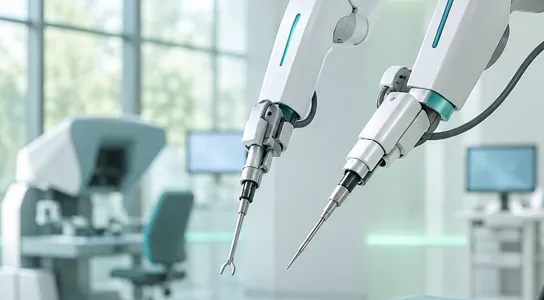


Robotic sigmoid colectomy for diverticulitis
Most planned diverticulitis operations remove the sigmoid colon through a few small incisions, with a robotic system guided by the surgeon. Here is what actually happens in the operating room.
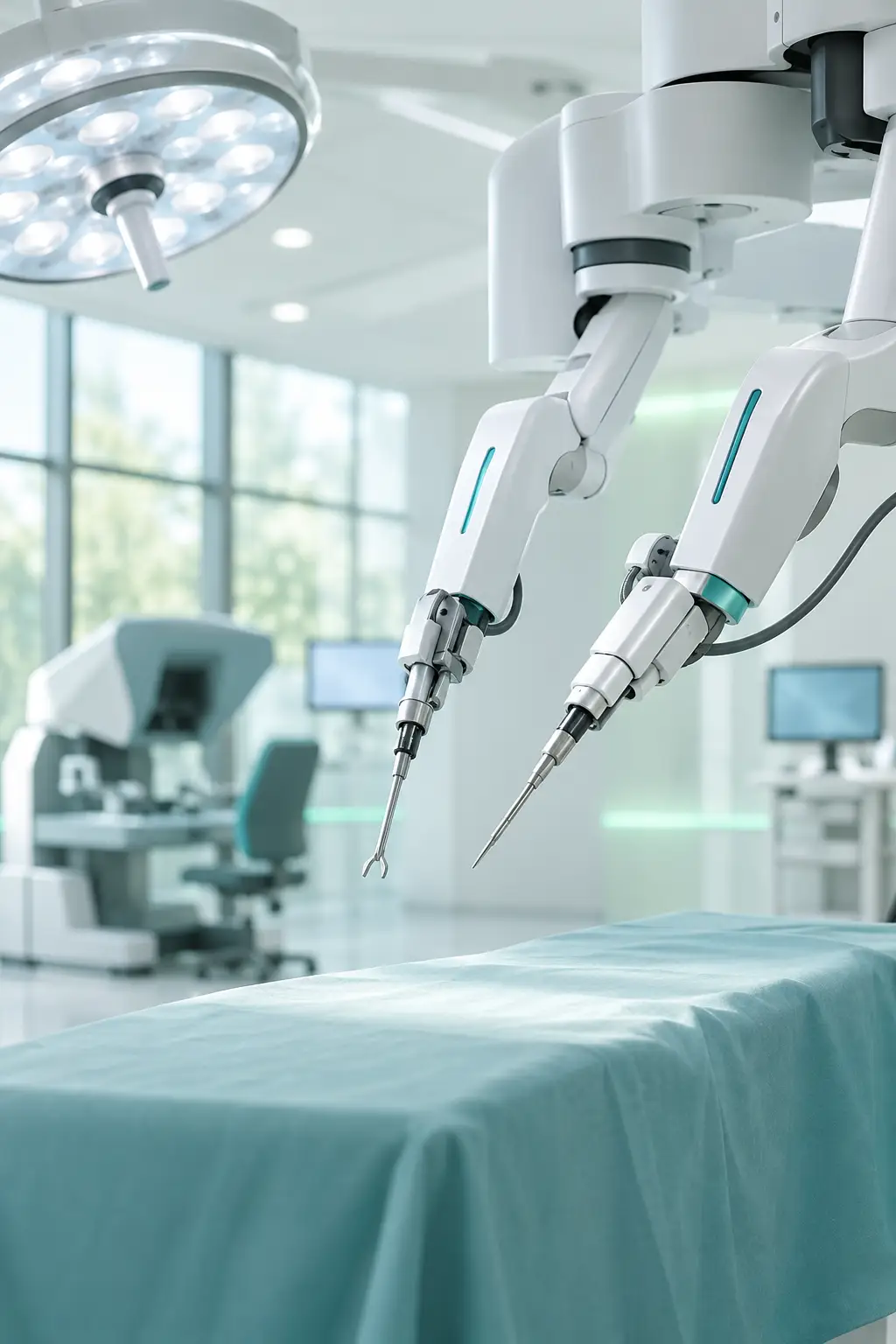
The robot holds the instruments. The surgeon makes every move.
A robotic system cannot operate by itself. Your surgeon sits at a console a few steps from the table and controls each arm with their hands and feet. The system follows those movements, scaled down and steadied, so fine work in a small space is easier.
What it adds is a magnified 3D view and instruments that bend like a wrist. That helps most deep in the pelvis, where the sigmoid colon meets the rectum. Compared with open surgery, the small incisions usually mean less pain and a shorter hospital stay.
A sigmoid colectomy, step by step
A simplified walk through a typical planned case. Every operation is adjusted to the patient and what the surgeon finds.
- Step 1
General anesthesia and a few small incisions
You are fully asleep. The surgeon makes several small openings in the belly and fills it gently with gas to create room to work.
- Step 2
The instruments and camera go in
Thin robotic instruments and a camera pass through the openings. The surgeon sits at a console in the same room, looking at a magnified 3D view.
- Step 3
The sigmoid colon is freed
It is carefully separated from the tissue around it. Nearby structures, such as the ureter that drains the kidney, are identified and protected.
- Step 4
The diseased section is removed
The colon is divided at healthy points above and below the inflamed pouches, and that section comes out through one slightly larger incision, usually low on the belly.
- Step 5
The ends are joined
The healthy colon is connected to the top of the rectum, usually with a stapling device. This join, the anastomosis, is tested for leaks before anything else happens.
- Step 6
The incisions are closed
Instruments come out and the small openings are closed. The whole operation usually takes a few hours, depending on how much inflammation and scar tissue there is.
The join that lets you skip the bag
The goal of the operation is not only to remove the inflamed colon but to reconnect what is left, so stool keeps passing the usual way. That connection is called an anastomosis.
Before finishing, the surgeon tests the join, often by filling the bowel with air under water to look for bubbles. Blood flow to both ends is checked too. In most planned cases the join is sound, and you wake up without an ostomy.
When a temporary ostomy may still be needed
Sometimes the safest choice is to let a fresh join rest, or to wait before joining at all. Stool then leaves through a small opening on the belly into a pouch for a while.
This is far more common in emergency surgery, which is one reason planning the operation matters. When it does happen, it is usually reversed later in a smaller operation once everything has healed.
Reasons a surgeon may choose one
- A lot of active infection, an abscess or contamination at the time of surgery
- Bowel tissue that looks swollen or has a poor blood supply, so a join may not heal well
- A join that does not pass the leak test in the operating room
- Health factors that slow healing, such as long term steroids
Your surgeon will tell you before surgery how likely this is in your case, so it is never a surprise.
After a robotic colectomy
Many people are up and walking the same day or the next morning, and eating soon after. Many go home within a few days. The pace after that depends on your health, your job and how the operation went.
Questions about robotic colon surgery
Performed by Dr. Yosef Nasseri and Dr. Moshe Barnajian at Cedars-Sinai Medical Center. See also colovesical fistula repair and whether diverticulitis can come back after surgery.
Is robotic colon surgery better than laparoscopic surgery?
Both are minimally invasive and use small incisions. The robotic system gives the surgeon a magnified 3D view and wristed instruments that can help in the tight space of the pelvis. Experience matters more than the tool, and your surgeon will recommend the approach that suits your case.
How big are the incisions for a robotic sigmoid colectomy?
There are several small incisions, roughly the width of a fingertip, and one slightly longer incision used to remove the section of colon. They usually heal into small scars.
Does the robot do the surgery?
No. The robotic system cannot move on its own. Every movement comes from the surgeon's hands at the console, and the surgeon is in the room throughout.
How long will I be in the hospital?
Many people go home within a few days, once they are walking, eating and their bowels are starting to work. Your surgeon will tell you what to expect in your case.
Can every diverticulitis operation be done robotically?
Not always. Heavy scar tissue, earlier abdominal surgery or an emergency can call for a laparoscopic or open approach. Switching to open during surgery is a safety decision, not a failure.
Related reading
- Surgery
Diverticulitis surgery explained
Who it helps, the operation and recovery in one overview. - Complication
Colovesical fistula
When the colon connects to the bladder, and how it is repaired. - Article
Can diverticulitis come back after surgery?
Why it is uncommon and what lowers the odds. - Complication
Colon stricture
Slow narrowing after repeated inflammation.
Bring your scans. Leave with a plan.
Wondering whether your colon can be removed robotically, and how likely you are to need an ostomy? Bring your CT scans and we will answer both for your case, along with the timing that suits you.